

Current as of 11/9/2026.

In early October of 2026, my husband retired from the military, and my family enrolled in our first-ever civilian healthcare plan.
I have a deep new appreciation for how much y’all suffer as you navigate open enrollment every year. I thought I was empathizing pretty well, but there are many things that you can’t fully understand until you’ve gone through them yourself. Like childbirth, or purchasing healthcare in the United States.
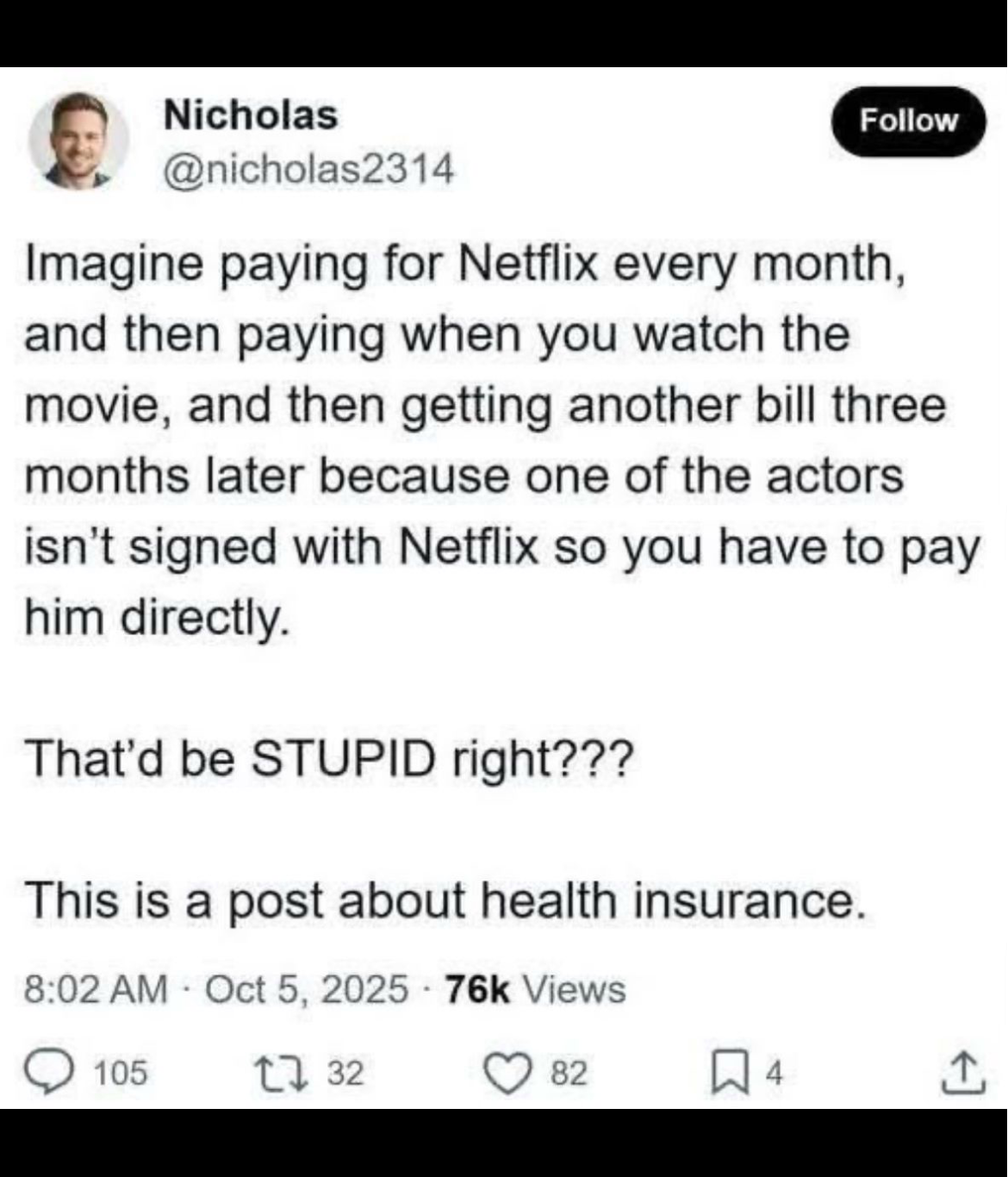
I’ll tell you all about Baby’s First Healthcare Decision, and share the tool I built after navigating this with myself and several clients… after the break.
The Break
If you’d like to get resources like this sent directly to your inbox, consider subscribing to my newsletter!
A Small Survival Kit for Open Enrollment
I built this Health Plan Comparison Tool for a bunch of reasons.
- A lot of plan tools won’t let you compare more than 3 plans at a time, even when they’re showing you, like, 40. (And all the names look the same!) I wanted a tool to narrow competitive choices down to 3.
- I like being able to filter and sort information because I’m a nerd.
- I didn’t really understand how civilian health insurance worked, and building something like this usually helps me figure it out.
Here’s how to use it: make a copy, plug in the plans you’re considering, and sort by whatever matters most to you. Below, I’ll walk through what each column means and why it matters.
2027’s Key Numbers
- Open Enrollment Dates: November 1, 2026 through January 15, 2027. To have coverage start January 1, enroll by December 15.
- HSA Limits: $4,500 individual / $9,000 family
- FSA Limit & Rollover: 2027 limit TBA (2026 was $3,400, with $680 rollover)
- HDHP Minimum Deductibles: $1,750 individual / $3,500 family
- Dependent Care FSA Cap: $7,500 per household
One other note: these terms and the calculator should broadly apply whether you’re enrolling through your employer or through the Marketplace. There may be small differences; if you need help demystifying, email hi (at) fortunamoney.com.

Now, on to key terms!
Premium (specifically, your portion of the premium)
You definitely have to pay this amount. This is what you are billed (or what gets taken out of your paycheck) every month. If you’re on the Marketplace, this is your premium after any tax credit.
For annual comparison math, the comparison tool uses your Annual Premium, which is your portion of the premium multiplied by 12.
Deductible
This is how much you will have to pay before insurance starts covering any costs. Not all payments count towards your deductible.
Read the fine print: A lot of plans will cover preventive/screening care and immunizations fully regardless of your deductible, and will charge you a copay for an in-network primary care visit but will still cover most of it below your deductible. You should check to see what care is covered for your specific needs before committing to a plan.
Despite what some people say, meeting your deductible does not mean that the rest of your care is covered for the rest of the year. There’s a fun little thing called Out-of-Pocket Max that we still have to talk about. Because until you hit that, you’re probably still going to be splitting the bill thanks to a lovely little thing called……
Coinsurance
This is about where I started to lose my mind when I was choosing our plan. Coinsurance is the amount (usually a percentage, but sometimes dollars) of your eligible expenses that you will pay for care, and your insurance will pay the remaining percentage (after you’ve met your annual deductible).

Example: If your plan has 20% coinsurance, you pay 20% of any medical bill, and insurance pays 80%.
What you pay in coinsurance usually counts toward your OOP max, although sometimes out-of-network care doesn’t count.
Family plans add a twist. Some have an embedded deductible: each person has their own deductible inside the family one, and coinsurance kicks in for that person once they hit it. Others are non-embedded: nobody’s coinsurance starts until the whole family deductible is met. Look for those words in your plan documents. Super fun, right?
Copay
A flat fee you pay for a specific service, like $30 for a doctor visit or $15 for a prescription. Depending on your plan, copays may apply even before you’ve met your deductible. These usually count toward your OOP max.
Out of Pocket Maximum
After you meet your deductible, your policy probably still expects you to pay some costs. This is where your Out of Pocket Maximum (OOPM) comes in. Your OOPM should be the absolute most you have to pay for covered medical services in a year. Generally, this includes any applicable deductible, copayments, and/or coinsurance (but not your premiums, because of course not why would it).
Your OOPM also includes the portion of any eligible expenses that insurance doesn’t pay.
After you hit your OOPM, your insurance company should start paying 100% of the costs. (Heads up: many plans have separate in-network and out-of-network OOP maxes, and spending toward one doesn’t count toward the other.)
Read the fine print: Again, many plans cover preventive/screening care and immunizations fully regardless of how far you are from your OOPM. Many will charge only a copay for an in-network primary care visit and cover the rest even if you haven’t hit your max. Always check to see what care is covered for your specific needs before committing to a plan.
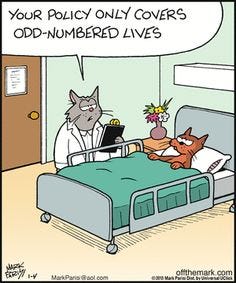
As with deductibles, things get a lil squirrelly on family plans, but this one works in your favor. Most plans cap each person at an individual OOPM, even on a family plan (the ACA requires this for most plans). Once one person hits theirs, their covered care is paid in full for the rest of the plan year, even if the rest of the family hasn’t hit the family max.
Two Numbers Worth Comparing (and a Real-World Example)
- Annual premium + deductible: what you’ll very likely pay if you need any non-preventive care this year.
- Annual premium + OOP max (your yearly total): your worst-case scenario of total annual spending on healthcare.
Is it especially likely that you’ll hit your OOP max in a given year? No, not really.
Is it possible, even if you’re a healthy, delightful, physically fit person under 35? Unfortunately, yes.
I give you: A Tale of Two Extremely Unlikely Injuries (shared with permission).
I know this amazing young couple. The wife (31) is a strong, athletic, experienced surfer… and when a rogue wave dumped her onto a sandbar earlier this year, her femur (HER FEMUR) snapped like a pretzel stick.

One rod-implanting surgery and multiple months of PT later, she’s doing great.
Right as the wife is getting back on track, the husband (33), a physically fit former NCAA Div I athlete, decided to try mountain biking. He knew he wasn’t experienced, so he took a path over to the easy trails. On his way there, he hit a rock, flipped over the handlebars, and fractured his shoulder blade like a cell phone screen. (Do you know how hard that is to do?)
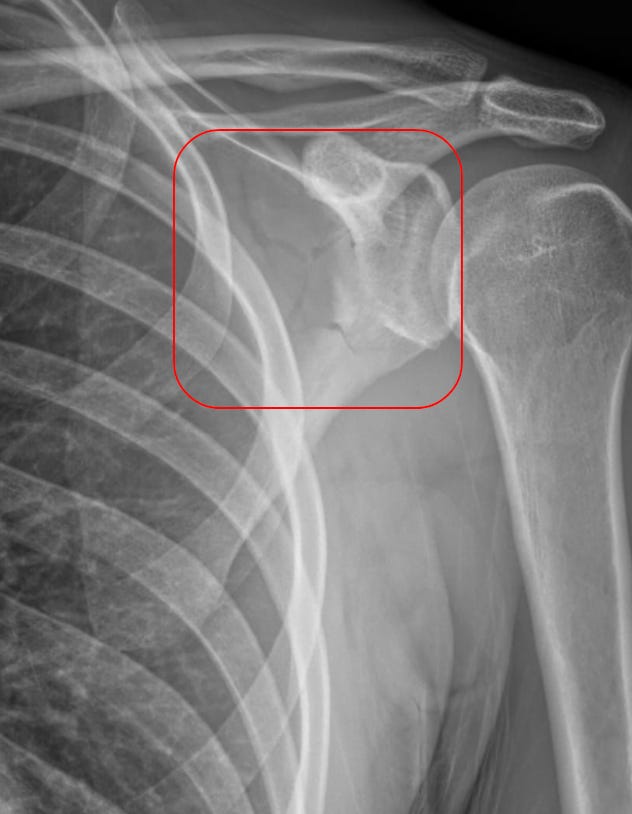
Back to the ER they went… followed by more months of PT. Fortunately, they were insured. Suffice it to say, they’ve hit their OOP max for the year.
I checked in to see if this couple’s medical misadventures had changed how they felt about insurance planning. Here’s what they said:
“Last year, we looked into going for a lower deductible plan, but the extra cost didn’t seem worth it for what we would save in the event we met our out-of-pocket max on the high deductible HSA-eligible plan. Turns out we did meet our OOP max, but we are not in the business of living our life like we’ll have 2 major catastrophic medical events a year! In the end, it cost us something like $1-2k more going for this plan, which is a lot – but it still feels worth it to go HSA.”
(We’ll talk more about HSAs in a minute.)
I will note that part of the reason this approach works for this couple is that they have eliminated a lot of risk elsewhere in their financial lives: no debt, strong savings, and a lot of smart choices all-around. If you are well-positioned to absorb a worst-case scenario in the unlikely event it comes to pass, this approach may work for you too! BUT, I don’t want you forced to take on high-interest debt to cover an OOP max that’s too big for your current financial situation.
Which is why we have a calculator. 🤓
Pro tip: if you hit your OOP max, it is likely worth scheduling any covered, medically necessary care you’ve been putting off to take place before your plan year resets.
Ask the Magic 8 Ball (a.k.a. the plan site’s cost estimate)
Many enrollment sites will give you a total cost estimate (sometimes a number, but perhaps a color or a row of dollar signs). No matter what beautiful imagery they use, the gist is the same: this is how much the mysterious health plan calculator guesses you’ll spend over the whole plan year. This number is usually the sum of your annual paycheck cost + what the site estimates your out-of-pocket costs will be.
This estimate is usually more precise if you put more details in, such as how many visits you have per year, what medications you’re on, how often you see specialists, etc. Otherwise, I suspect they are just running it off of vibes demographic/actuarial data. Take it with a grain of salt, but it can give you a sense of what is likely to happen and not just what is possible (which my calculator will show).
FSA, HSA, WTF?
These accounts offer tax advantages: both can be funded by pretax dollars, and withdrawals on both are tax-free as long as they are used for qualified medical expenses. Employers can also offer “seed” or “matching” contributions for both funds (although it’s not super common for them to do that with FSAs) – and we love free money!
FSA
Stands for “Flexible Spending Account.” This account is famous for “use it or lose it” funds, meaning most of the money won’t roll over from year to year.
The good stuff: Your full annual election amount is available on day 1 of your plan year, even though your contributions come out of your paycheck gradually. So if you elect $3,000 and need a $2,000 procedure in January, you’re covered.
The catch: If you don’t spend it, you lose it (except for a small rollover, if your plan allows one). If you leave your employer, you usually lose access to the funds. You also can’t invest the money; it’s more like a checking account. People are always looking for smart ways to spend down their FSA before the deadline. (If you’ve spent FSA money on something fun, tell me in the comments!)
Note: there are also Dependent Care FSAs for eligible childcare expenses which work in similar ways, now up to $7,500 a year — at the very best, a small fraction of a year of childcare. 🫠
2027 limits: Not announced yet. For 2026, the limit was $3,400, with up to $680 rollover.
Who can choose an FSA: Anyone whose employer offers it!
When you should choose an FSA: When you are reasonably confident that you will spend most of it, because you’ve got predictable and/or recurring medical, dental, or vision expenses.
HSA
Stands for “Health Savings Account.” This account is cool because it’s all yours (even if you leave your employer!), and it rolls over from year to year.
The good stuff: People get excited about HSAs, and for good reason.
- The money goes IN tax-free; the money GROWS tax-free; the money comes OUT tax-free for qualified medical expenses at any age (doctor visits, prescriptions, dental, vision, even some Medicare premiums)
- After 65, you can withdraw it for anything. Non-medical withdrawals are taxed as ordinary income, like a traditional IRA, but with no required minimum distributions.
- Many HSA providers also let you invest once your balance passes a minimum (often $1,000).
The catch: You can only open one if you’re enrolled in an eligible High Deductible Health Plan (HDHP). For 2027, that means a deductible of at least $1,750 individual / $3,500 family, and an OOP max of no more than $8,700 individual / $17,400 family. (Most HDHPs have way higher deductibles than that minimum.) Starting in 2026, Marketplace bronze plans count too. You also can’t pair an HSA with a regular FSA, though a limited-purpose FSA for dental and vision is fine. And once you enroll in Medicare, you can’t contribute anymore.
2027 limits: $4,500 individual / $9,000 family, plus an extra $1,000 if you’re 55 or older.
Who can choose an HSA: Anyone enrolled in an eligible HDHP.
When you should choose an HSA: You’re generally a low-cost, low-catastrophe medical patient; your employer is contributing free money to it; you have a pretty good deal on a plan that allows it; you’re well-insulated against risk elsewhere; and you could cover the deductible if something big happened.
Other Terms to Know
Plan Types
- HMO (Health Maintenance Organization): Cheapest but most restrictive, usually with a small, local network. You’ll need a primary care physician (PCP) and referrals for specialists, and out-of-network care generally isn’t covered except in an emergency.
- EPO (Exclusive Provider Organization): The middle path. You need to stay in network, but you can self-refer and usually don’t need a PCP. Medium flexibility, medium expensive, medium network.
- POS (Point of Service): Like an HMO, you’ll usually need a PCP and referrals, but you can go out of network for a higher cost.
- PPO (Preferred Provider Organization): Most expensive but most flexible, with the largest network. No PCP or referrals required, and out-of-network care is covered (for a higher cost). Usually has the highest monthly premiums.
Marketplace Metal Tiers
If you’re shopping on the Marketplace, plans are also sorted into metal tiers. These tell you roughly how costs are split between you and your plan: Bronze plans cover about 60% of average costs, Silver 70%, Gold 80%, and Platinum 90%.
Bronze Plans:
Bronze plans have low premiums and really high deductibles. These can make sense if you don’t usually need more than preventive care AND have enough in savings to cover your deductible. In theory, this is the cheap bare minimum.
Silver Plans
These are a middle path (medium premiums, medium deductibles), with one important benefit for low-income households: cost-sharing reductions are permanent ACA subsidies that lower deductibles, copays, and coinsurance – but not your premiums. If your income is low enough to qualify for “cost sharing reductions” or “extra savings,” you can save a lot, but only if you are on a silver plan, and only if your income is low enough to qualify (generally 100-250% of the Federal Poverty Level).
Gold Plans
These typically have the highest premiums, but you pay the lowest out-of-pocket costs when you actually get care. These plans can make sense if you know you’ll definitely use a lot of care, or if you’re more comfortable with a high, predictable cost than the possibility of catastrophe.
Platinum Plans
Platinum plans have the highest premiums and the lowest costs when you get care. They aren’t offered everywhere.
The Ol’ DIY Approach
If you’re self-employed or your job doesn’t offer insurance, you’ll shop on the federal Health Insurance Marketplace or your state’s exchange. Don’t let last year’s plan auto-renew without looking, because a lot changed this year:
- Less help with premiums. The extra-generous premium tax credits (PTCs) expired. Above 400% of the Federal Poverty Level, you get no help at all. (Extra fun since premiums went up about 13% on average.)
- Uneven income? Be careful. Your PTC is based on your estimated earnings. If you earn more than you estimated, you have to pay back the difference at tax time. As of 2026, there’s no cap on how much. Update your estimate whenever your income changes — if you earn less than you estimated, you can claim the PTC you should have gotten as a refund, so it’s worth it to dial this in.
- Lower your income (on paper). HSA and traditional or SEP IRA contributions lower your MAGI, which can mean a bigger credit. (Bonus: Marketplace bronze plans now count as HSA-eligible.) You can also deduct student loan interest or harvest capital losses.
If you’re a business owner or an independent contractor, you can pay careful attention to income and expense timing, claim every legal business expense you can, and most of all… - Deduct your premiums. If you’re self-employed, you can generally deduct premiums for yourself, your spouse, and your dependents, as long as you weren’t eligible for an employer plan (including through a spouse’s job). There are several specific requirements to do this correctly, so check in with your tax pro to make sure you get the full benefit of this.
Finally, a small reminder that healthcare is a major public policy issue that’s being decided by our elected officials. I’m not a policy expert, so I try to learn from thoughtful explainers like this long read or this podcast episode. If you’re someone who likes to call your senators/representative, these are worth checking out.
Big thanks to Megan Glosson for revisions, fact checking, and self-employed healthcare insightss!

